Varya spent the first half of this month in Russia getting her parents’ apartment ready to rent and visiting friends in Moscow and family in Saratov. She brought back some of her folks’ documents and keepsakes, including this 100 ruble note issued in 1910, perhaps handed down by one of their grandparents who grew up in the late Russian Empire, though Varya suspects her Dad simply picked it up somewhere as a collectible.
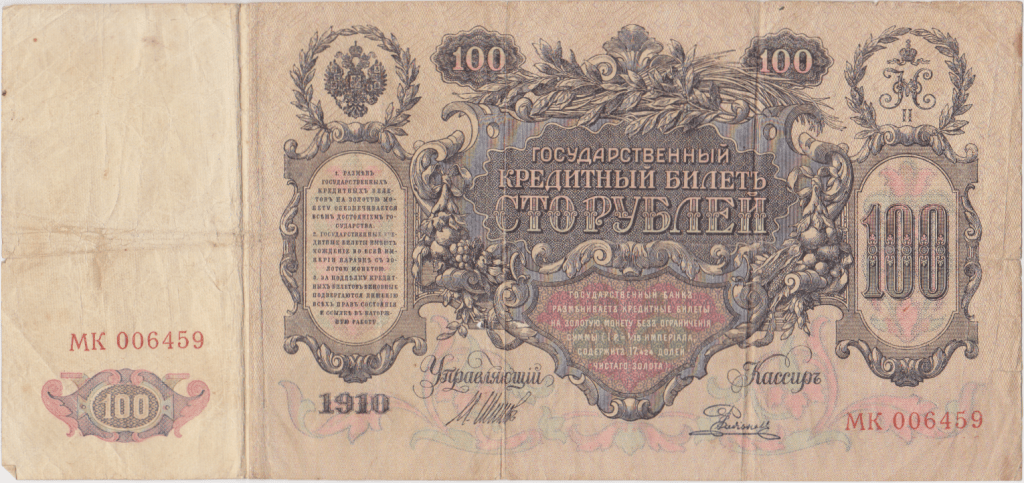
These days, 100 rubles would be worth about a buck fifty, but that’s not a valid conversion for this old money. The Russian ruble has been redefined/reset several times since the days of Tsar Nicholas II (whose “N II” crown seal is in the upper right corner), first by the Communists and a few more times during the 1990’s, a decade of financial and societal turbulence in Russia following the collapse of the Soviet Union. It’s more informative to read the reddish section in the lower center, which states this Russian government note may be exchanged for real gold at a rate of 15 rubles per imperial gold coin. So, this 100 ruble note would have been worth 100/15 or nearly 7 gold coins, a tidy sum for a member of the proletariat under the last Russian Tsar. Unfortunately, the Russian Revolution would render it worthless just seven years later.
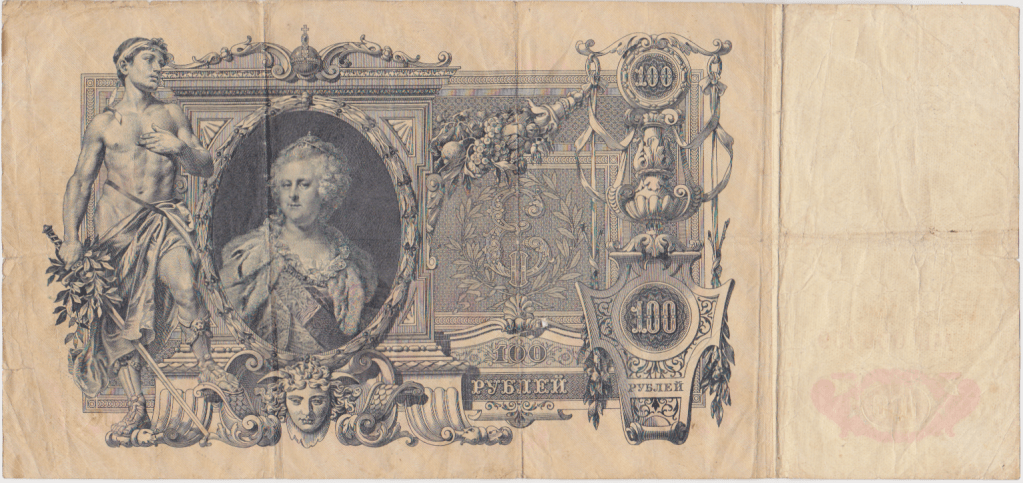
Not unlike some of our US currency picturing fancy wigged dudes from a couple centuries past, this 110 year old ruble note featured Empress Catherine II, aka “The Great”, as she was still revered over a century after her death. The fancy E to the right of her image stands for Ekaterina, the Russian form of Catherine. At 26 cm (10.2″) wide and 12 cm (4.7″) tall, this is a big bill! So, the creases showing it was folded into a 1/8 area square are not surprising…how else would you carry this big, valuable paper around?!

 Moonday