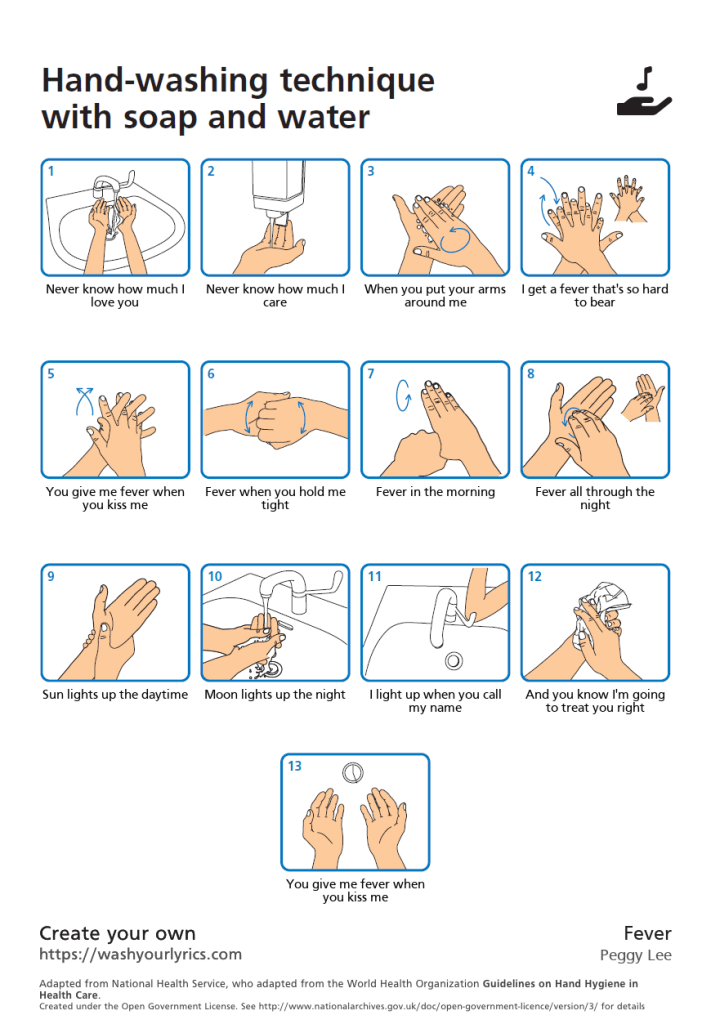
As we all know now, while social distancing and self-quarantining, the first, (repeated) middle, and last thing to do every day is wash your hands, wash your hands, and wash your hands. After riding droplets coughed or sneezed out by an infected person into your mouth–greatly mitigated by ~2 meters (~6 feet) of social distancing–the coronavirus’ favorite path into your body is from a public surface to your hands to your face. Some have noted that singing Happy Birthday twice roughly clocks the 20-30 seconds of thorough hand-washing necessary to mechanically remove viruses from your hands…but such a boring song! To sing something much cooler (and more appropriate?) while washing your hands correctly, enter a song title and artist at WashYourLyrics.com, and the site will generate a downloadable & printable “Hand-washing technique” poster with your chosen lyrics under infographics so you can wash and sing in sync. You may need to try different songs to get a desired fit: I first tried It’s the End of the World as We Know It by R.E.M., but got the intro lyrics rather than the more recognizable titular chorus. My next try worked much better: Fever by Peggy Lee…
I first met US Astronaut and Navy Captain Scott Kelly while he was training in Moscow (Москва) and Star City (Звёздный городок) during my 4-year tour in Russia and Kazakhstan supporting the International Space Station (ISS). Scott’s a very cool and funny guy, definitely the sort you’d want to calmly handle a stressful situation in the air or space (or at the Volga Hotel in Moscow). A veteran of several Shuttle, Soyuz and ISS missions, he famously spent a year aboard ISS to study prolonged zero-G living over the kind of duration required for a human Mars mission someday, and later wrote the NY Times best seller, Endurance: My Year in Space, a Lifetime of Discovery. OK, Scott’s an impressive dude, but what does he have to do with coronavirus?! Hopefully very little beyond his NY Times article yesterday (21-Mar-2020): I Spent a Year in Space, and I Have Tips on Isolation to Share. Here’s a summary of his advice for being stuck at home (with a few of my comments interjected), based upon his experience being stuck in space, enticing you to read his full article:
- Follow a schedule for structure and normalcy, even when stuck at home. I still have my alarm set for every morning…admittedly an hour later than before since I don’t necessarily have to shave, shower, and dress for teleworking these days (teleworking is pants optional).
- But pace yourself, because we’re in this for the long haul, so make time for fun. I’m not sure Scott watching the 8th season of Game of Thrones twice qualifies as fun, but point taken.
- Go outside every day, because nature rules (forget that coronavirus is natural), and reduces stress. Even with social distancing, this is so much simpler to do on Earth than on the ISS!
- You need a hobby, an outlet that isn’t work or home maintenance. Scott took a digital guitar trainer and paper books to orbit (at how many $K/kg?!). I’m counting this blog as a hobby.
- Keep a journal, writing about your daily experiences and memories. Scott used his journal to write a popular book. Varya adores fancy Japanese paper journals, while I prefer digital apps–more searchable, cheaper, lighter, and take up far less space in my office (electrons are so tiny).
- Take time to connect with people remotely using your phone, tablet and/or computer. Isolation damages mental and physical health, actually lowering your immunity to viruses (oops), so this becomes more important the longer we self-quarantine.
- Listen to experts, not crazy internet sites, Facebook posts, YouTube videos, far right/left commentators, or even friends spewing fake remedies, cures, rumors, and bad advice. Scott recommends the John Hopkins Coronavirus Resource Center and WHO, and you should also listen to the CDC and your city & state health officials. Remember, social media like Facebook and Twitter are neither your friends nor real news, but merely entertainment, as informative and useful as pro wrestling, political propaganda, and cat videos.
- We are all connected, as is obvious when viewing the borderless Earth and its thin atmosphere from space, and when humans face a borderless pandemic (or alien invasion, planet-killer asteroid, etc.).
- Wash your hands–often, now singing along with your Fever-synched hand-washing poster!
So that’s what to do individually, but what should we as a species expect of this pandemic, and how should we fight it? With all due respect to Capt. Kelly, let’s turn to a real expert, epidemiologist Dr. Larry Brilliant (good career/name pairing; Dr. Fever would have been cooler). Brilliant helped eradicate smallpox and contain SARS (bird flu), and for many years has been arguing for a global early warning system for identifying and containing pandemics. Before consulting on the 2011 movie Contagion (now trending again in iTunes…go figure) to communicate this need to the public, he gave a prize-winning TED2006 talk, Help Me Stop Pandemics. Watch his TED Talk to learn how…
- He helped WHO track down every case of smallpox in the world to eradicate this ancient lethal/scarring/blinding disease from the planet by 1980!
- Early detection and early response using GPHIN helped conquer the SARS epidemic, “the pandemic that didn’t occur”, and are the keys to attacking…
- The next big pandemic could spread worldwide in a few weeks, halt air travel, trigger global recession (or depression), cost the US economy $1-3 trillion, cause mass unemployment, and if it infects a billion people around the globe, kill up to 165 million of those according to models. He said this in 2006, but at least some of this is happening now: coronavirus spread worldwide in a month or two, airplanes are empty of passengers, markets are crashing, Congress is talking about more than $1 trillion in response/stimulus, and the infection rate continues to accelerate in the US and Europe. China curbed their infection rate by locking down large sections of the country, testing and tracing contacts of infected people. South Korea curbed their rate with rapid response including early mass testing, contact tracing and targeted quarantine. These examples show that mass testing/tracking and strict social distancing/isolation/quarantining can mitigate the spread of infections. So, perhaps we can slow it down enough to keep the peak well under a billion, at least until anti-viral drugs and vaccines for coronavirus (hopefully) are available next year.
Steven Levy–renowned tech writer/editor for Wired magazine and a host of other publications previously–published his interview with Larry Brilliant in Wired’s Science section last week (19-Mar-2020): The Doctor Who Helped Defeat Smallpox Explains What’s Coming. Here are a few take-aways from Steven’s interview with Larry, which you should read in its entirety when you get a chance:
- Dr. Brilliant describes coronavirus as “the most dangerous pandemic in our lifetime,” but believes we can beat it with quick, strong action including a lot more testing.
- The term novel preceding coronavirus simply means it’s new, so humans have no immunity to it (yet) and everyone is at risk until we survive infection and disease and (assuming it acts like other viruses) develop immunity, and/or develop a vaccine for worldwide distribution, likely next year.
- He applauds current state government directions–self distancing/isolation, closing schools and some businesses, canceling events and gatherings–while criticizing the early slowness, denial and misinformation from some federal government officials lacking expertise.
- Slowing down or flattening the curve does not decrease the total number of cases (the area under the curve), but rather postpones many of them (1) to avoid overwhelming hospital capacity (as in Italy), and (2) until we get a vaccine in 12-18 months.
- Epidemiologist “Gold Ring” = combination of two factors to create herd immunity (70-80%):
- Enough of us have caught and survived the COVID-19 disease to become immune
- Vaccine developed, tested, mass produced and globally distributed
- It will be hard for the US to follow the Chinese model of strict national lockdown, but we should be able to follow the South Korean model, including rapid mass testing to clearly understand where the virus really is and how fast it is spreading or receding in those areas.
- US coronavirus response should be centralized under an experienced person like “Ebola Czar” Ron Klain, perhaps retitled Covid Czar, with the respect of public health and political communities. Dr. Tony Fauci of the NIH is the closest we have to that so far.
- If you’re not worried, you’re not paying attention, but don’t be scared. We can slow down the virus and increase the odds of getting a vaccine or at least a prophylactic antivirus medication in time to avoid a much bigger disaster. This is not the zombie apocalypse. (Whew!)
- N95 mask pores are 3 times wider than the virus. However, these masks still provide significant protection. Think of a huge bunch of football players trying to rush through a single door–a few will make it, but slowly, and many won’t. So, we need to get many more masks to health professionals, as they do help a lot.
- Before we can beat this thing and the world starts looking normal again, we need 3 things:
- Measure virus distribution (mass statistically designed testing program)
- Vaccine or antiviral treatment that works
- Large numbers of people are identified as immune (herd immunity), especially in public professions that make us comfortable returning to schools, hospitals, etc.
- Brilliant is encouraged by seeing civic engagement and volunteerism in the face of pandemic, especially among our youth (did he miss Spring Break videos showing thousands of idiots/carriers crowding beaches?!), and a huge influx of medical professionals putting in more hours than they’ve ever worked before.
- Coronavirus is an equal opportunity infector that does not see red or blue states or pink or red hats. So, perhaps we’ll come out of this seeing ourselves more united, more alike than different (with less denial and ignorance of science and true expertise!).
(Next post: After Pandemic)

 Moonday
One thought on “During Pandemic”