Perseverance and Ingenuity

Earlier this month, after a 7-month journey from Earth, our Mars2020 mission landed the Perseverance rover on Mars in the Jezero Crater, near an ancient riverbed (yes, Mars once had thousands of rivers and lakes before the water froze, though some liquid water may still flow seasonally). If you haven’t caught up on the fantastic videos (and audio!) from this historic mission, don’t waste another second, check them out here:

  • First, in full screen mode with your volume up, watch these very cool Perseverance entry, descent and landing and Ingenuity Helicopter animations on YouTube so you understand what’s happening as early videos and images come back from Mars. The first animation starts with the quiet arrival at Mars before slamming into the Martian atmosphere at about 20,000 kph (12,500 mph) to begin “7 minutes of terror”, ending with Perseverance in a cold, desolate Martian landscape. The second animation shows the deployment and first flight of Ingenuity (in a few weeks), our first flying drone on another planet…helicopters on Mars!
  • Then watch the on-board views of descent and landing, including…
    • Parachute deployment. BTW, within hours people online had deciphered the secret message hidden in the parachute markings: using binary numbers and ASCII code, it spells out DARE MIGHTY THINGS, a quote from Teddy Roosevelt and informal JPL credo, as well as some significant coordinates
    • Heat shield jettison, after it protected the lander from atmospheric entry temperatures up to 1300 °C (2370 °F)
    • Back shell (with parachute) separation from the rocket-powered Sky Crane
    • Sky Crane lowering of the big, SUV-sized Perseverance rover to the surface
  • Take your time browsing around the NASA Mars 2020 Perseverance Rover main site offering links to other images, videos, audio, animations and info
  • Come back weekly to check out the latest Mars images sent back by Perseverance, including the public choice for Image of the Week

You might be wondering why we don’t get real-time 4K HD video streaming from Mars. After all, Perseverance has high-tech sensors and cameras, and clearly is able to send back cool images and videos. What it lacks is a broadband connection back to Earth. Think of it as your slow internet connection 20 years ago, when you could browse the early web and (slowly) download files, but today’s live HD video streaming was not an option. It takes a while for Perseverance to transmit data, images and video back to Earth, even going through the Mars Reconnaissance Orbiter (MRO), and those signals take up to 20 minutes to reach us, even traveling through interplanetary space at the speed of light.

Go Perseverance and Ingenuity!

Little Galaxy of Horrors

First, an historic anniversary: it was 20 years ago today, Sgt. Pepper taught the band to play…um…actually, Bill Shepherd, Yuri Gidzenko, and Sergei Krikalev–aka Expedition 1–arrived at the new, small International Space Station (ISS) on 2-Nov-2000, beginning 2 decades of human habitation and research and ISS expansion in Earth orbit. At no time in the 21st century has there not been people living 400 km above us, traveling at nearly 8 km per second. Happy 20th anniversary, ISS! While you contemplate the first 2 decades of continuous human presence in space, consider the future possibility of traveling far beyond Low Earth Orbit (LEO) to other worlds…

In addition to exploring the Earth, Moon, Sun, and the rest of our local solar system, NASA explores the Milky Way galaxy, including Exoplanet Exploration. The “exo” in exoplanets refers to planets far outside our solar system, orbiting other stars many lightyears away (“light year” = distance light travels through space in a year = several billion kilometers or miles). It’s only been in recent decades that NASA has gained the technological tools to find and study exoplanets–so far nearly 4300 exoplanets confirmed in over 3K distant solar systems, and counting. Astronomers have long assumed that planets orbit other stars just like our local planets orbit the Sun, and now we know that planets are extremely common in our galaxy! Wonder if life is common as well?! TBD…

Galaxy of Horrors

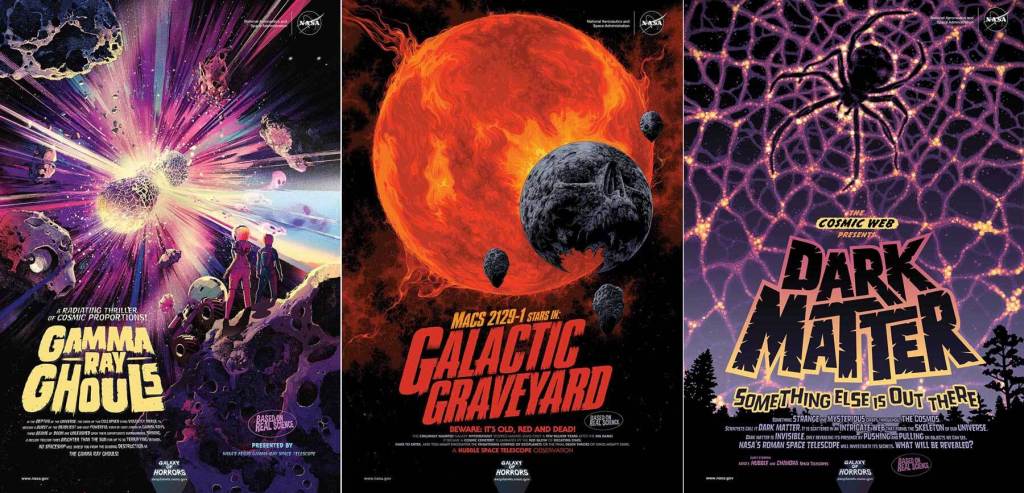
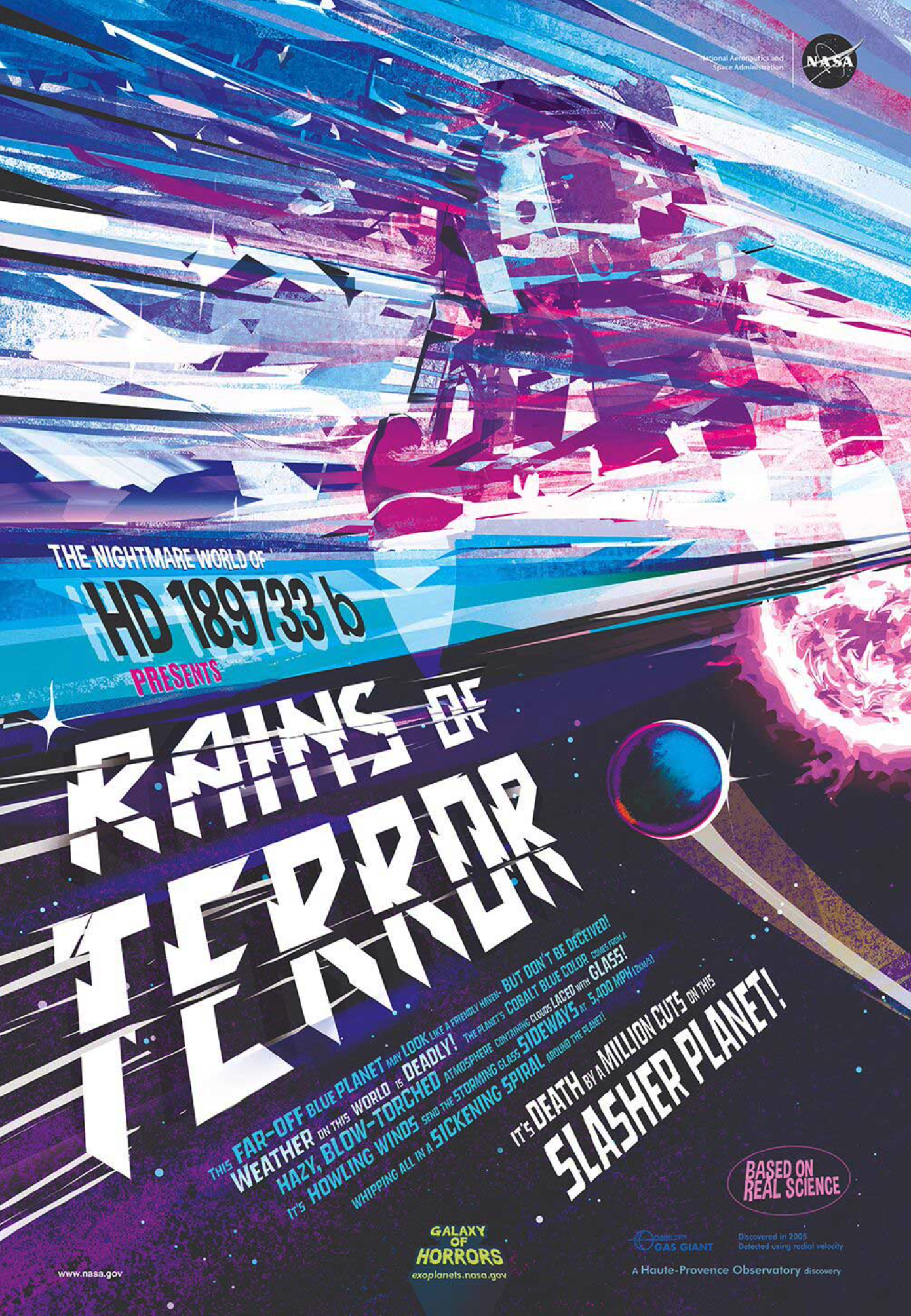
In the better late than never category: NASA’s way cool Galaxy of Horrors site offers downloadable “classic sci-fi/horror” style posters and interactive content so that you, too, can explore a few of the scarier exoplanets…if you dare. In addition to Gamma Ray Ghouls, Galactic Graveyard, and Dark Matter (Something Else is Out There!), check out Flares of Fury, Zombie Worlds, Rains of Terror and more. I’m pleasantly surprised to see NASA take this fun route for a little PR: HD 189733b just gained much more notoriety as “SLASHER PLANET!

TW@N

This Week @ NASA (<3 min video) features the upcoming SpaceX Crew-1 mission (NET late October) commanded by astronaut Col. Mike Hopkins, younger brother of one of my undergrad frat brothers back in MO. Small Earth.

While you’re on YouTube, also check out the NASA TV stream, if you don’t already watch it through other sources. My cousin Sean points out that for such a cool space agency exploring the universe, NASA’s TV channel is sometimes surprisingly…well…underwhelming. I can’t argue that it definitely could use better production values at times (NASA is high profile but low budget with only about 0.5% of federal funds), and can be repetitive if you watch it long enough, but it often offers very cool video for space buffs and the general public. Plus, I like to open the NASA app on my Apple TV (also available for iOS and Android) and have views of Earth from the Space Station playing as a serene, beautiful backdrop, and a reminder that astronauts from around the globe have been living together in orbit continuously for 20 years this November, and as you’re reading this. Give it a try.