Perseverance and Ingenuity

Earlier this month, after a 7-month journey from Earth, our Mars2020 mission landed the Perseverance rover on Mars in the Jezero Crater, near an ancient riverbed (yes, Mars once had thousands of rivers and lakes before the water froze, though some liquid water may still flow seasonally). If you haven’t caught up on the fantastic videos (and audio!) from this historic mission, don’t waste another second, check them out here:

  • First, in full screen mode with your volume up, watch these very cool Perseverance entry, descent and landing and Ingenuity Helicopter animations on YouTube so you understand what’s happening as early videos and images come back from Mars. The first animation starts with the quiet arrival at Mars before slamming into the Martian atmosphere at about 20,000 kph (12,500 mph) to begin “7 minutes of terror”, ending with Perseverance in a cold, desolate Martian landscape. The second animation shows the deployment and first flight of Ingenuity (in a few weeks), our first flying drone on another planet…helicopters on Mars!
  • Then watch the on-board views of descent and landing, including…
    • Parachute deployment. BTW, within hours people online had deciphered the secret message hidden in the parachute markings: using binary numbers and ASCII code, it spells out DARE MIGHTY THINGS, a quote from Teddy Roosevelt and informal JPL credo, as well as some significant coordinates
    • Heat shield jettison, after it protected the lander from atmospheric entry temperatures up to 1300 °C (2370 °F)
    • Back shell (with parachute) separation from the rocket-powered Sky Crane
    • Sky Crane lowering of the big, SUV-sized Perseverance rover to the surface
  • Take your time browsing around the NASA Mars 2020 Perseverance Rover main site offering links to other images, videos, audio, animations and info
  • Come back weekly to check out the latest Mars images sent back by Perseverance, including the public choice for Image of the Week

You might be wondering why we don’t get real-time 4K HD video streaming from Mars. After all, Perseverance has high-tech sensors and cameras, and clearly is able to send back cool images and videos. What it lacks is a broadband connection back to Earth. Think of it as your slow internet connection 20 years ago, when you could browse the early web and (slowly) download files, but today’s live HD video streaming was not an option. It takes a while for Perseverance to transmit data, images and video back to Earth, even going through the Mars Reconnaissance Orbiter (MRO), and those signals take up to 20 minutes to reach us, even traveling through interplanetary space at the speed of light.

Go Perseverance and Ingenuity!

Holiday Tea Parties

Varya topped her bewitching Hallows Eve Tea Party with two more extravagant tables for two this holiday season, on my birthday and again on Christmas Day.

Birthday Binge

The incredible spread my multi-talented wife laid out earlier in December started with pistachio & cherry scones, then descended 3 tiers with crab salad canapés, sweet potato canapés topped with chorizo, and smoked turkey & cranberry cream cheese sandwiches, and finally topped it all off with my favorite dessert, tres leches con fresas! No ketosis that week.

Birthday Tea Party
Pistachio & Cherry Scones with Cream
3 Tiers of Tasty
3 Milks of Mmmmmmmmmm

Yuletide Yum

For Christmas dinner, Varya took it to the next level in terms of variety and artistry. Beef and radish canapés led it off, followed by crab and chive sandwiches, and roasted grape and brie tartlets with fig spread and (everything’s better with) bacon for an enticing sweet/cheesy/savory combo. Climbing the 3 tiers were orange almond scones topped with whipped cream and/or lemon curd, creamy lemon & raspberry tartlets, and cardamom butter cookies dipped in white chocolate and sprinkled with pistachios. The centerpiece/masterpiece was her maple pecan cake with cream cheese frosting adorned with “holly & berries” made of rosemary & sugared cranberries. We’re still finishing leftovers, so no keto until next year.

Christmas Day Tea Party
Surf, Turf & Tartlets
Scones o’ Plenty
Tart Tartlets
New Favorite Cookie
New Favorite Cake
Edible Artwork
Varya’s Fanboy (before food coma)

The Right Thing

“Americans can always be counted on to do the right thing…after they have exhausted all other possibilities.”

Variants of this quote are popularly attributed to Sir Winston Churchill, presumably in reference to the US finally joining the fight against fascism in WWII. Though it may sound like something he’d say, there is no written or recorded evidence that Winston ever made such a statement. In fact, it may be more accurately attributed to Israeli diplomat Abba Eban in 1967, though he referred to “nations” rather than specifically “Americans”.

Little Galaxy of Horrors

First, an historic anniversary: it was 20 years ago today, Sgt. Pepper taught the band to play…um…actually, Bill Shepherd, Yuri Gidzenko, and Sergei Krikalev–aka Expedition 1–arrived at the new, small International Space Station (ISS) on 2-Nov-2000, beginning 2 decades of human habitation and research and ISS expansion in Earth orbit. At no time in the 21st century has there not been people living 400 km above us, traveling at nearly 8 km per second. Happy 20th anniversary, ISS! While you contemplate the first 2 decades of continuous human presence in space, consider the future possibility of traveling far beyond Low Earth Orbit (LEO) to other worlds…

In addition to exploring the Earth, Moon, Sun, and the rest of our local solar system, NASA explores the Milky Way galaxy, including Exoplanet Exploration. The “exo” in exoplanets refers to planets far outside our solar system, orbiting other stars many lightyears away (“light year” = distance light travels through space in a year = several billion kilometers or miles). It’s only been in recent decades that NASA has gained the technological tools to find and study exoplanets–so far nearly 4300 exoplanets confirmed in over 3K distant solar systems, and counting. Astronomers have long assumed that planets orbit other stars just like our local planets orbit the Sun, and now we know that planets are extremely common in our galaxy! Wonder if life is common as well?! TBD…

Galaxy of Horrors

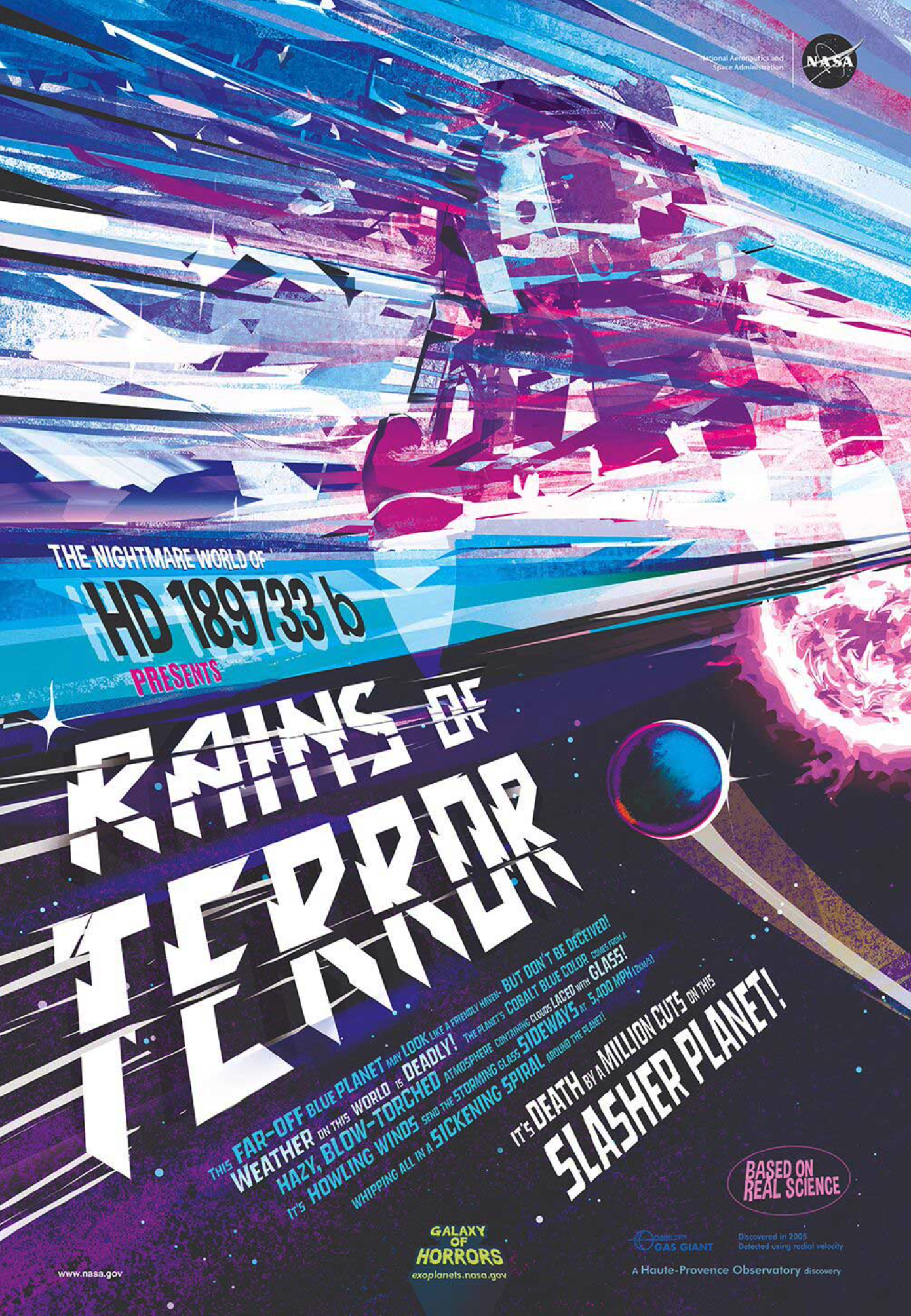
In the better late than never category: NASA’s way cool Galaxy of Horrors site offers downloadable “classic sci-fi/horror” style posters and interactive content so that you, too, can explore a few of the scarier exoplanets…if you dare. In addition to Gamma Ray Ghouls, Galactic Graveyard, and Dark Matter (Something Else is Out There!), check out Flares of Fury, Zombie Worlds, Rains of Terror and more. I’m pleasantly surprised to see NASA take this fun route for a little PR: HD 189733b just gained much more notoriety as “SLASHER PLANET!

Hallows Eve Tea Party

Varya practiced her high sorcery in the kitchen, adapting British “spells” found in Tea Time magazine to concoct a wicked Halloween afternoon tea party for two.

Varya’s Halloween Tea Party
1st Course: Curried Butternut Squash & Apple Soup
2nd Course: Smoky Pimento Cheese and Walnut Sandwiches, Chicken Chutney Sandwiches
3rd Course: Date, Chive & Parmesan Scones with Cream
Side Tiers of More Sandwiches, Scones and Almond Cookies with Cinnamon Pear Jam
4th Course: Orange Cake on Skull Plates
5th Course: Chai Spice Ice Cream (yes, she made that, too)

Oh, and she made tea.

China Keemun Tea

6th Course: nap (aka food coma).

Holiday Pandemic

As the coronavirus pandemic grows worse than ever in the US, here is a summary of guidance on if and how to gather during the holidays:

CDC

  • Staying home is the safest option, avoiding the increased risk of spreading the coronavirus and COVID-19 to your relatives and yourself, but if you must take the risk and gather, consider..
    • Community level: Check the number and rate of COVID-19 cases in the gathering location and where travelers may be coming from and through
    • Location: Outdoor gatherings are less risky (and colder) than indoor
    • Duration: Shorter gatherings are less risky (and less filling) than longer
    • Number: Fewer people pose less risk (and less noise) than large groups
    • Travel: Local trips are safer than distant travels, especially if people are traveling from multiple locations
    • Behavior: Responsible people–who wear masks, maintain social distance, and wash hands–pose much less risk than irresponsible people who refuse these basic preventative measures
  • People should NOT gather if they…
    • Have symptoms of COVID-19 or the disease itself
    • Are still awaiting results of COVID-19 tests
    • May have been exposed to someone with COVID-19 in the previous 2 weeks
    • Are at increased risk of severe illness or death from COVID-19
  • CDC also provides guidance for hosts, travelers and revelers

Wired

  • Staying home is the safest option, given there is no perfectly safe way to gather, but a difficult choice for many families, so…
  • Talk to relatives openly ASAP about how you plan to protect them, your immediate family and yourself
    • Don’t feel pressured into taking uncomfortable or even dangerous risks
    • Don’t judge those who opt out this year
  • People not in the same household (or larger “pod”) pose the same risk to each other as strangers, so maintain social distance and wear masks as you would in public
  • Testing everyone in advance helps mitigate risk, assuming all results are negative, but is not a guarantee, since people may become infected anytime after the test sample was taken, or may get a false negative result (25% of the time with some tests) and still be infectious (this may be the case in some of the White House’s super-spreader events)
  • Eating together increases risk, since people remove masks and spread droplets and vapor by breathing, talking, coughing, sneezing

USA Today

  • Holiday parties potentially spread infections, even if small and only with relatives, as evidenced by infections traced to weddings, funerals, religious gatherings and other everyday group events
  • CDC advice may be mocked by some who feel it infringes upon their “freedom” (to infect?), at their relatives’ and their own peril
  • There is no ideal choice between risks (loss of health and life) vs isolation (loss of in-person camaraderie and rituals this holiday season)
  • Test types: Antigen tests are usually quicker (and sometimes cheaper) but less accurate than “gold standard” PCR tests.
    • My wife and I just took a PCR test with saliva samples that claims 90% accuracy but takes 36 hours for results.
    • The same clinic offers an antigen test that provides results within 15 minutes but with only 75% accuracy (1 in 4 chance of false negative).

Post Truth

Social Dilemma

The Social Dilemma, a Netflix “documentary-drama hybrid,” does an impressively good job describing visually, dramatically, and in simple, understandable terms to a non-techie audience (e.g., your Facebook-addicted elderly relatives) the dangers posed by global social media networks like Facebook, Twitter and YouTube upon ourselves and our society. The entertainingly educational 90-minute movie shows how largely unfettered machine learning algorithms on these sites manipulate and addict you with one goal: keep you engaged as much as possible (whether enthralled or enraged matters little), clicking and tapping, so they can charge advertisers more for a larger user base, and they gain ever more data on your behavior, preferences and emotional triggers to sell to advertisers and to fine tune your targeted, individualized manipulation and addiction in an endless spiral. As the modern saying goes, if you’re not paying for social media, you’re the product, not the customer.

The Social Dilemma relies upon expert insiders–some of them responsible for creating the algorithms that learn to hook you–and fictional families to explain and dramatize how the relentless, amoral pursuit of growth by social media giants led to giant social problems, such as enabling mass manipulation by advertisers and propaganda peddlers on an unprecedented scale, connecting and emboldening conspiracy theory cranks and bad actors around the globe, giving foreign adversaries cheap-n-easy direct access to US voters for disinformation campaigns, and offering authoritarian regimes tools for surveillance, control and even genocide. It has never been easier to grow the ranks of flat earthers, climate science deniers, anti-vaxxers, Qanon believers, white supremacists, and angry mobs than now when Facebook/Twitter/YouTube algorithms lead susceptible users down dark rabbit holes of misinformation, successfully increasing engagement as “outrage machines.” The docu-drama spends a lot less time on detailed solutions to these urgent problems, though it does touch on a bunch of tips for average users at the end (e.g., turn off notifications, limit your screen time, delete the phone app, or simply delete your account). I highly recommend checking it out on Netflix (whether you already subscribe or just want to try it for a month) for your own education and awareness. As a target for manipulation, you should learn how it works so you can recognize and fend it off.

Confronting Misinformation

I first read Scientific American in the late 70’s, when my step-dad subscribed to it. I later subscribed myself, first in paper then digital, before more recently getting it as part of my Apple News+ subscription (along with Wired, Motortrend, National Geographic, Rolling Stone, and many others…not a bad deal). The November issue focuses on Confronting Misinformation: How to protect society from fear, lies and division…quite timely given the rising tide of misinformation in recent and current campaign seasons.

With The Social Dilemma still on my mind, one of the November SciAm features in particular caught my eye: Trolling for Truth on Social Media, by Joan Donovan, a social scientist faculty member at the JFK School of Government at Harvard University. Her article harkens back to a simpler time in the late 80’s and early/mid 90’s, long before your senior relatives had even heard of the Internet, when going online meant you were at college (.edu) or work (.com or .gov), or later at home with a dial-up modem commandeering your only phone line, when we early adopters shared files, software, technical info, homework and perhaps some dialog in usenet groups and early email accounts, but not personal data, and we certainly didn’t buy anything online. Many viewed the rapidly expanding Internet clad with the newly accessible World Wide Web as a public tool for information and democracy…hello world, you’re welcome! Dr. Donovan traces our online history from those naively idyllic beginnings into the modern digital economy, first driven by porn (like VHS in the 70’s), later by more general sales sites, eventually by social media giants who figured out how to convert users’ personal data into a marketable commodity, for sale to other corporations, political organizations, and even governments. Agencies in the latter figured out how to use social media to surveil and manipulate people in other countries, and even their own citizens. Dr. Donovan describes some of the tactics used by these good and bad actors, for good or ill.

While I enjoyed the walk through the digital history of the last few decades and learned some tricks of the trade, I awaited the punch line at the end, when she speaks to how those who still care about truth and public access to it might fight back against the online flood of dis/misinformation around the world and here in the US. It starts by losing our naïveté and “dispatching with the ideology that technological platforms are democracy in action.” By design, social media and misinformation incentives are “weighted in favor of disinformers,” given “novel claims travel far and fast,” racing past and drowning out boring old truth. If such harmful incentives are inherent in the current design of social media, a redesign is in order, i.e., design to incentivize truth over dis/misinformation, or at least to achieve a better balance for a more “equal-opportunity media ecosystem.” Our “techno-nostalgia” and era of laissez-faire attitudes toward the Internet and the global media/information companies that use it must come to an end if we are to rescue truth on social media for our own social and democratic health.

TW@N

This Week @ NASA (<3 min video) features the upcoming SpaceX Crew-1 mission (NET late October) commanded by astronaut Col. Mike Hopkins, younger brother of one of my undergrad frat brothers back in MO. Small Earth.

While you’re on YouTube, also check out the NASA TV stream, if you don’t already watch it through other sources. My cousin Sean points out that for such a cool space agency exploring the universe, NASA’s TV channel is sometimes surprisingly…well…underwhelming. I can’t argue that it definitely could use better production values at times (NASA is high profile but low budget with only about 0.5% of federal funds), and can be repetitive if you watch it long enough, but it often offers very cool video for space buffs and the general public. Plus, I like to open the NASA app on my Apple TV (also available for iOS and Android) and have views of Earth from the Space Station playing as a serene, beautiful backdrop, and a reminder that astronauts from around the globe have been living together in orbit continuously for 20 years this November, and as you’re reading this. Give it a try.

Cost Cutting

In 2018 I wrote about Cord Cutting, my experience dropping my overpriced DirecTV satellite TV service several years ago and relying solely upon Internet TV & movie streaming services. Cord cutting saved some money, but was also about choice, chasing the a la carte TV dream: only paying for what you want rather than 500 channels of useless crap, and turning services on and off monthly as needed rather than being stuck in bloated long term contracts. (That post remains mostly applicable two years later, though all of the quoted costs have increased.) As the COVID-19 pandemic spread worldwide early this year, like many people I focused on cutting costs, trimming the fat from monthly bills, subscriptions, and online services. So, Cost Cutting is an update to Cord Cutting, providing a few ideas on how to save more than a few bucks, especially for those unfortunate souls still overpaying an “Evil Corp” (the likes of Comcast, Charter, DirecTV, AT&T or Verizon) for TV/phone/internet bundles. Time to go all Marie Kondo and streamline your connected life!

Streaming Apps & Online Subscriptions

First, I saved nearly $60/month by dropping Hulu (no ads), Sling (Orange + Sports Extra) and Netflix (Premium 4K). I only had Hulu for late-night comedy/talk shows (watched in the morning over coffee and breakfast) and The Handmaid’s Tale. My wife found the latter too depressing (fascist religious fanatics take over US Gov…a little dark), and I could record the late-night shows with my HDHomeRun Extend box, cheap antenna, and $30/year (<$3/month) HDHomeRun DVR service. I was only using Sling for watching sports on ESPN (1, 2 & 3) and the Tennis Channel (w/ Sports Extra), so once the pandemic shut down most sports, turning off Sling was a no-brainer. Despite enjoying Patriot Act on Netflix, I found it was easy to let the red N go as well. Last month we restarted Netflix for the final season of the sci-fi series Dark (so German), and my sister Claire’s recommendation, the dark comedy Dead To Me (Christina Applegate is great…who knew?!), but having finished those, we’ll probably turn it off again. I kept these subscriptions and apps:

  • HBO Max: $15/month, formerly HBO Now
  • Apple TV+: free for a year with recent device purchase (otherwise $5/month)
  • Disney+: $70/year = $6/month, mainly for Star Wars, Marvel & Pixar movies, not to mention Jeff Goldblum and, of course, Baby Yoda on Mandalorian
  • Amazon Prime Video: included with Prime Membership ($120/year = $10/month)
  • PBS Video: free by default, though I donate $5/month to PBS for their excellent catalog
  • Comedy Central, 60 Minutes, TED Talks, video podcasts and YouTube videos, all free (with ads)

Next, I reduced my Audible audiobook subscription from Gold at $15 for 1 book credit every month, to Silver at the same price every other month, saving ~8/month. (All those books in my GoodReads list at right were audiobooks, so it really should be GoodListens.) I mainly listen to books with my iPhone while driving, so my audiobook listening time plummeted along with car time due to teleworking, and books took longer to finish. In fact, I later canceled Audible altogether (still keeping purchased audiobooks), though I recently restarted again to replenish my unread/unheard library. If you’re new to Audible, you’ll likely see only Gold and Platinum membership options, and wonder how to get the cheaper Silver. The answer is to use the same leverage you have over all monthly subscriptions and services: threaten to cancel. As soon as an Audible member clicks to cancel their subscription, the Audible site tries to keep you by offering lower cost alternatives such as the “secret” Silver level. Sneaky bastards to be sure, so you have to know how to play the game.

Internet Service

With little competition at the high end of broadband service, cable is still the best Internet option in our area. The growth of optical fiber networks (e.g., Google Fiber or Verizon Fios) has slowed to a crawl in the US, hasn’t reached our neighborhood, and DSL generally remains a slower, less reliable choice (you can only get so much out of a twisted pair of skinny copper wires). Perhaps Elon Musk’s Starlink constellation will help disrupt/bypass cable Internet with fast-n-cheap satellite access, but that literally just got off the launch pad. Cable companies such as Comcast and Charter pay…er…lobby legislators hard to keep their local monopolies on cable service, so for us, cable = Comcast.

I dropped my Comcast Internet bill from >$90 to $50/month by dropping my speed from 200Mbps to 75Mbps (speed tests show we actually get 90Mbps most of the time), which is sufficient for 2 non-gamers streaming simultaneously (a large family with gamers may need more shared bandwidth). Since 2018, Comcast finally stopped forcing a TV/internet bundle to get the best Internet price, acknowledging that many people no longer want their bloated TV packages. So, I now pay Comcast the minimum for Internet access only (forcing the switch from HBO Go to HBO Now/Max noted above). I call Comcast about once a year to make sure I have their cheapest Internet option, since they’re always changing options and prices. Comcast phone reps sometimes have access to options not shown on their web site, so ya gotta call. Of course, I always purchase my own cable modem (currently a Motorola MB7621), which is much cheaper than renting Comcast’s Xfinity modems.

Mobile Phone Service

In the Before Times, pre-pandemic, we were paying AT&T over $50/month (>$600/year) for Varya’s iPhone service, capped at 1GB of data. Years ago AT&T hit us with over-charges for exceeding that monthly cap when she accidentally left her phone on streaming music videos all night. We long ago switched her to an AT&T plan that simply slowed down above the cap rather than inflating the bill, but I was always on the lookout for a better alternative to AT&T. Enter Mint Mobile (thanks to Uncle Leo’s TWIT.tv network). Now for only $180/year = $15/month (!), she gets 3GB of data, far more than she ever uses in a month. If we paid Mint $25/month, half as much as we used to pay AT&T, she’d have 12GB, an order of magnitude more than AT&T’s low limit. The catch? Mint licenses the T-Mobile network, so you have to be in an area with good T-Mobile coverage, typically in or near cities. Fortunately, Varya gets great coverage in the greater Houston metro area, including driving downtown to work. When my Mom tried Mint, she found T-Mobile’s coverage was spotty out in the sticks of Misery…er…Missouri, so she returned to AT&T at over 3 times the price for their larger cellular network. (BTW, if you’re not too rural and want to try Mint Mobile, we both get a little bonus if you use my Mint referral link: http://fbuy.me/pFeNf)

Home Security Service

Your home security system is another often overpriced monthly service open to negotiation. When we bought our home in 2012, I signed up with ADT, locking myself into a 1 or 2 year contract at ~$45/month (silly boy, that was too high!). After the contract expired, I called ADT about the price, and they happily dropped it to ~$25/month…apparently they had a helluva profit margin to play with! Every year or two they’d increment the price, and when it got too high I’d call again to bring it back under $30/month. This year it increased to $36, and last month they sent an email suggesting it would increase again to $39. So, I called to cancel the service—remember, the threat of cancelation is always your best negotiating tool with any monthly service/subscription! They offered a “special pandemic price” of $15/month to keep me, and said I could ignore the price increase email…effectively acknowledging their recent price increases were BS, just squeezing extra profit out of loyal customers, assuming most wouldn’t notice or take action. In the increasingly competitive home security market—DIY newcomers like Ring Alarm and SimpliSafe are as low as $10/month—old companies like ADT must adapt to remain viable.

Bottom Line

How does all of that tally for my monthly costs? As of right now—and I could easily change it at any moment, which is what I love about cord cutting—my monthly pre-tax bill for all TV, audiobooks, Internet, cell phone, and monitored home security is $133 = $15 HBO Max + $16 Netflix Premium + $6 Disney+ (paid annually) + $5 PBS Video (donation, not required) + $3 HDHomeRun DVR (paid annually) + $8 Audible Silver + $50 Comcast Xfinity (75-90Mbps) + $15 Mint Mobile (paid annually) + $15 ADT Security. I may drop the $16 Netflix Premium, but restart the ~$30 Sling/ESPN/Tennis Channel for the US Open at the end of August, adding a net ~$14 this month, still keeping everything under $150. I don’t count Amazon Prime Video because I pay for Prime Membership for free 2-day shipping of my Amazon purchases and rarely watch their video service. I’m also not counting online movie rentals, because those are independent of streaming services—we typically use Apple TV to rent movies, but could easily use Prime Video, Vudu, or many other options at about the same cost per rental ($1-7). My “land line” phone service is free using Google Voice with an OBi200 VoIP box (and rarely used anyway).

So, the bottom line is that if you’re paying anything near or over $200/month for TV + DVR + Internet + audiobooks + cell & home phone + home security—or worse, just a subset of those—the bad news is you’re probably wasting money, and the good news is you have opportunities available now for cutting costs, maybe by half. Even if you’re afraid you’re not tech savvy enough to try cord cutting and managing various services a la carte, at the very least call your provider and say you want to cancel your bundled services due to cost—you’ll get transferred to a “retention specialist” who’s professional mandate is to keep you as a customer and thus who has the power to offer you deals and lower prices the first-line phone rep can not. Feel free to use any of the costs I quoted above as negotiation leverage…as I did by mentioning SimpliSafe to ADT. 😉

[2020-08-31 Updates: I recently called Comcast and dropped my Xfinity Internet plan to $45/month while increasing the quoted speed from 75 to 100 Mbps. This was one of the first times that the deals offered by the phone rep matched those offered online in my Comcast account, i.e., it would have been faster to change my own service online, since my Comcast guy was confused and slow. Meanwhile, Audible dropped the precious metal nomenclature, and now calls their top service Premium Plus ($15/month) and their lower level just Plus ($8/month). With Premium Plus, you own your audiobooks, whereas with Plus it appears you can only access them as long as you maintain your membership…not good. Both have an option to pay annually with a discount. Selecting the “Cancel membership” option no longer unlocks a secret half-price option, but rather enables you to pause for up to 3 months. This may work out even better than the old Silver/half-membership option if I can pause for 3 months, turn it one for 1 month and repeat this cycle, effectively having a 25% membership option.]

Discussing Diversity

Ant Pruitt is one of the nerdy technology podcasters I watch regularly—expert photographer, buff weightlifter, avid runner, black father. He talked last week about having to worry every morning about wearing bright, non-threatening running clothes to minimize the risk of surprising or scaring white people on his route—a risk underscored by white men chasing and killing Ahmaud Arbery as he was jogging—and having to talk to his young sons about reducing the risk of being profiled, harassed or killed by police. Clearly these are tough conversations American minorities must have for daily safety and survival in our country that most white Americans never need to consider. Ant stressed that in addition to whites, blacks and other minorities talking together about dismantling systemic bias and bigotry in the US, white folks need to talk about it amongst ourselves, even when black folks aren’t around, even when it’s not MLK Day or Juneteenth. It must be part of white culture as well as black for it to finally work this time.

I remember some white guys in my Missouri youth, typically older schoolmates, routinely using the n-word in attempted jokes and slurs, likely learned from their parents. As a shy kid, I winced inside but said nothing to those ignorant boys, and now remember my silence with regret. I remember being wary of some of the black kids bussed from downtown St. Louis to my north suburban junior high school, having little comprehension of or sympathy for their often rougher realities, and wish I’d had the strength and compassion to reach out more. That was then, this is now, and now I can talk about it privately with friends and family, and write about it publicly, here.

Kudos to NASA management, who from Administrator Jim Bridenstine to Center Directors to my immediate supervisors have made it clear with words and actions that NASA will maintain a diverse, tolerant, safe work environment, and for having direct, open conversations about the murder of George Floyd and subsequent protests of this and countless other incidents of unjustified police violence against black Americans. Such conversations acknowledge the still-current challenge of America’s long, tragic history of racist violence from native genocide and brutal kidnapping and enslavement of Africans and their American descendants through Jim Crow repression and today’s lingering injustices—in the “land of the free” that teaches we “are created equal”—only partly addressed by the Civil Rights movements and legislation of the last century. I’ve thought about posting some NASA managers’ heartfelt letters to employees, but more powerful is a recent JSC Diversity Panel discussion (also posted on YouTube) between 5 NASA leaders: JSC Director Mark Geyer, JSC Deputy Director Vanessa Wyche, SSC Assistant Director Daryl Gaines, JSC Deputy CIO Kofi Burney, and Astronaut and Navy Commander Victor Glover. Please take an hour to watch this video, noting these key points from their discussion and shared personal experiences:

  1. White people need to educate themselves, not expect black people to be their teachers.
  2. Even if you’re doing fine, have empathy for many Americans who are not doing fine.
  3. Engage in hard, open conversations as part of necessary healing, understanding and change.
  4. Daryl recounted having to calm a ranting, demeaning white traffic cop to de-escalate a potentially dangerous encounter on his way to work, a situation white drivers find annoying rather than threatening.
  5. Vanessa recounted having “the talk” with her son for his scholastic survival in a mostly white school with a bullying teacher, and for his literal survival when encountering police, which perhaps helped save his life when police errantly pulled guns on him at work. White sons rarely have to navigate around racist teachers and police.
  6. Victor recounted when he and his equally preppy college buddy were mistakenly ordered to the ground outside a K-mart and harassed by police until Victor’s father, a retired police officer, showed up just in time to de-escalate the situation and get his son away from the threat of police. Call this young black man lucky to have a cop as a father, helping him survive to later serve in the US Navy and Astronaut Corps.
  7. Kofi recounted how a job headhunter advised him to replace his given name—meaning “born on Friday” in Ghana—with his initials (something less African-sounding) to avoid the bias of racist hirers (who presumably would be surprised when he showed up for an interview). White job applicants don’t need to change their names to avoid racial discrimination.
  8. Vanessa recounted how Alex Haley’s Roots had a major impact upon her as a girl. (I remember the TV mini-series impacting me, making the textbook concept of generational slavery more visual, violent, demeaning, real.) Over dinner, her father expressed his hope that MLK’s vision would eventually come to fruition in the US, though still a long way off in the 1977…and 2020.
  9. Vanessa reminded us all to talk about these issues, events, and pain, even at work, if only to check on each other. She remembers that after a white supremacist murdered 9 black Americans and wounded 3 more in the 2015 Charleston church mass shooting, no one asked how she was, even knowing she was from South Carolina, as people tended to avoid such subjects at work even 5 years ago. We need to address racial hate and violence openly, no matter how uncomfortable the conversation.
  10. Mark shared that he feels he delayed reaching out a few days after George Floyd was tortured to death, perhaps not immediately seeing George as potentially his own son or relative. Understanding and change require broad empathy, especially among white Americans who enjoy societal privilege not enjoyed by minority Americans.
  11. NASA strongly supports employees who exercise their 1st Amendment right to peaceful assembly. No one should be afraid of retribution for joining peaceful protests. Great to see our most senior directors state this unequivocally.
  12. People around the world strongly support and are inspired by Americans justly protesting systemic racism and racial violence, and join us demanding action and change.

Isn’t progress long overdue? Isn’t it shameful that we still fall so short of American ideals in 2020?